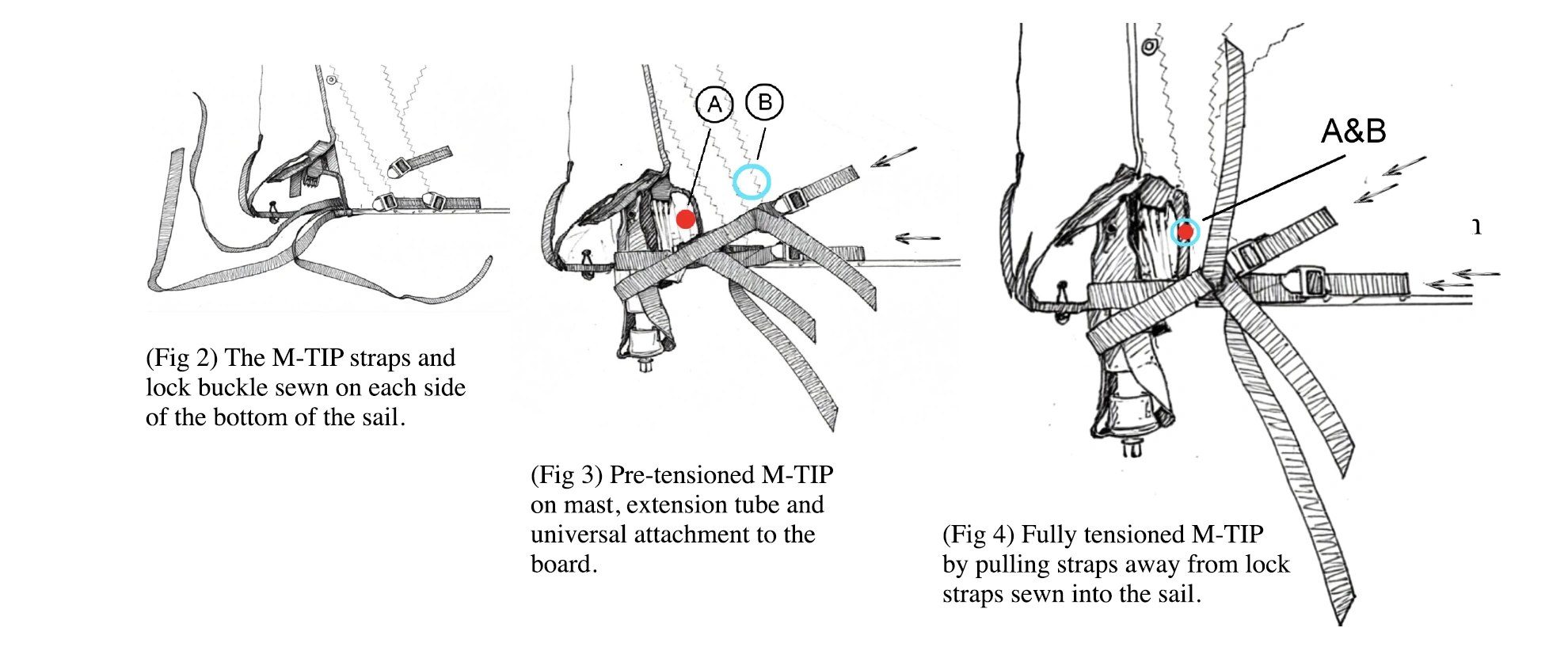
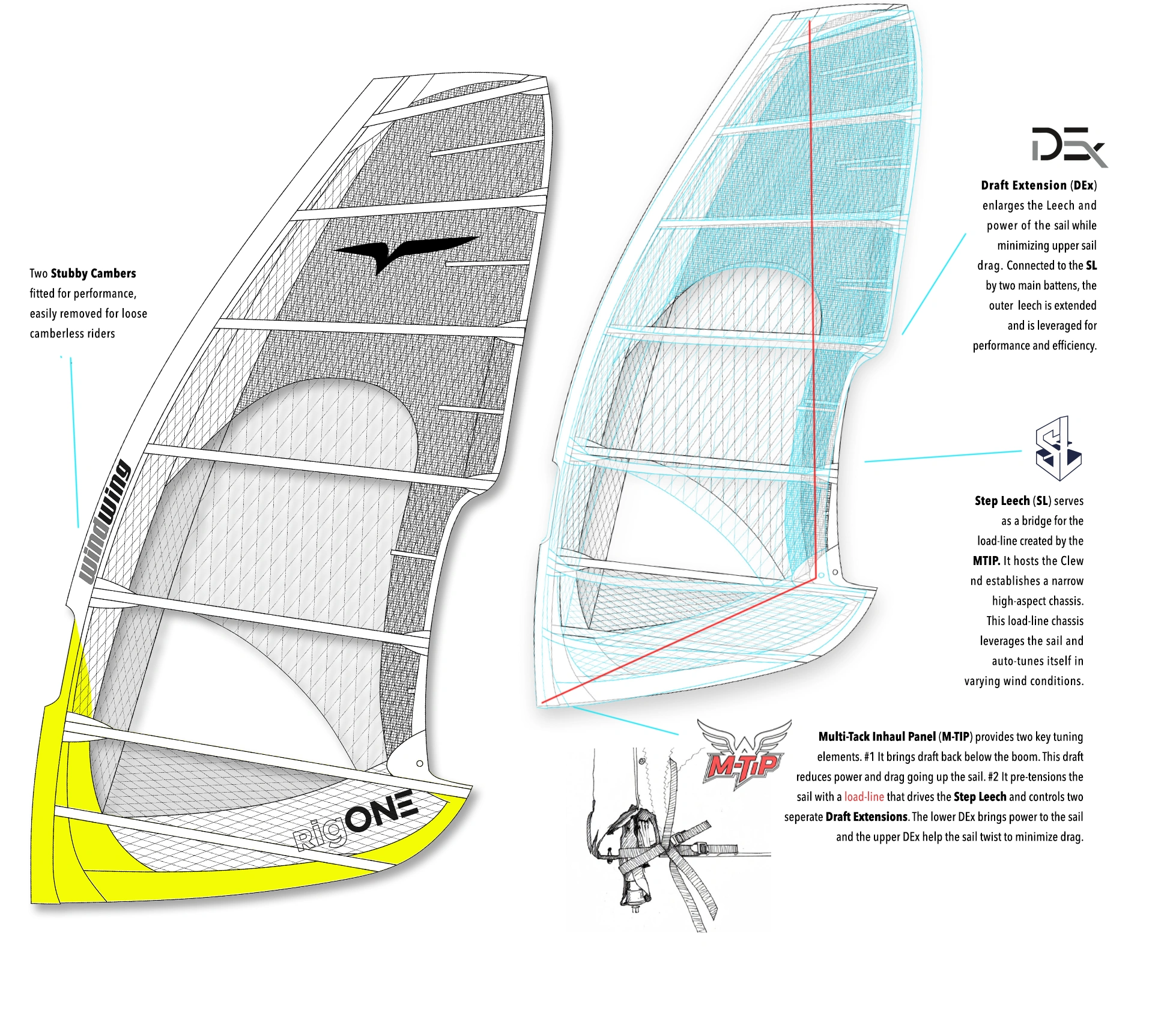
At the heart of the RigONE is the addition of a load-bearing point at the base of the sail. We call this the Multi-Tack Inhaul Panel or M-TIP. It’s a simple set of multiple adjustable lock straps attached behind and away from the tack of the sail. When the straps are wrapped around the base of the mast and pulled through the lock buckle (Fig 3), the foot of the sail is folded accordion-like towards the mast (Fig 4). This brings the draft back to what otherwise would be a flattened sail.
With M-TIP, power is brought back below the boom and diminishes as it tapers up the mast. With power below the boom and drag minimised above, the RigONE offers thrilling speed and control, without the urge to rig down.
The RigONE incorporates three new provisional patent design elements into a windsurfer sail. Starting with the Draft Extension (DEx), an upper and lower DEx, extends power into the sail without increasing drag. This is made possible by the Step Leech (SL), a bridge that hosts the sail’s clew at the bottom while controlling the upper and lower DEx. At the heart of RigONE is the Multi-Tack Inhaul Panel (M-TIP), which creates critical load-line tension (red line below) in the sail. This load-line is where the SL is located and drives the DEx functions. The combination of the three enables the sail to self-tune to changing wind conditions.
Not for everyone but, for YOU!
The crazy, the misfit,
the troublemaker,
the round peg in a square world,
the windsurfer they can’t ignore because your sail… changed things.

Secure Your Spot
Early production availability, exclusive pricing, insider updates.
Limited sails available