
Fully Controllable, Adaptable and Adjustable
While RigONE sails are designed to reduce reliance on equipment, they still require a specific type of mast to achieve optimal performance.
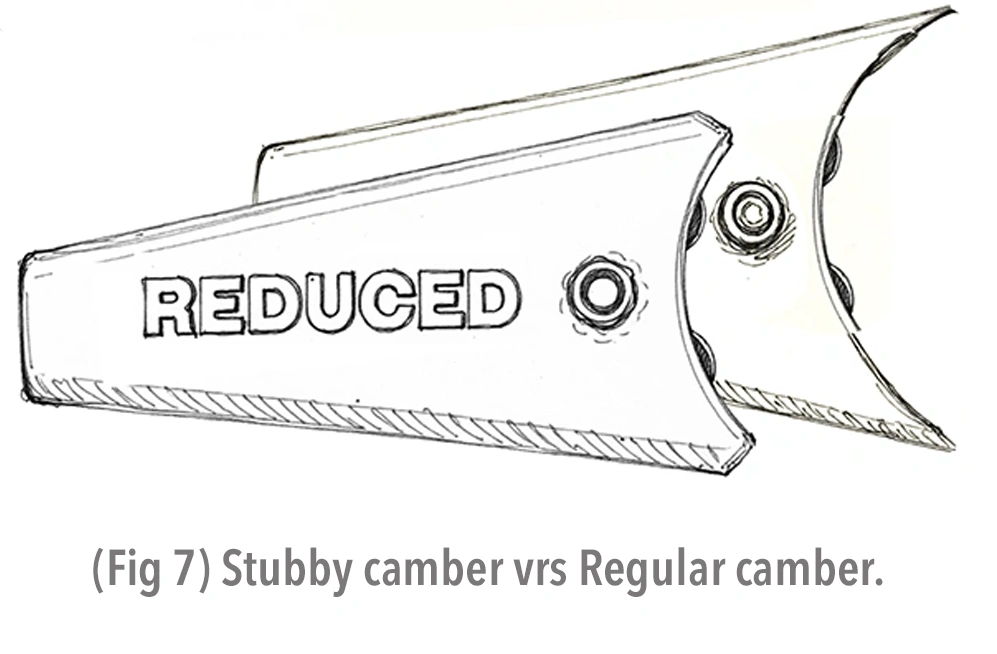
The RigONE is designed around a constant-bend, reduced-diameter ( RDM ) mast. This mast, known as a “skinny” mast, plays a key role in our goal of reducing aerodynamic drag. The RDM ‘s constant-bend flex characteristics allow for smooth rotation of the two ” Stubby ” cambers (Fig. 7). These “Stubby” cambers stabilize the glide profile while remaining easy to handle. Different flex characteristics exist among RDM masts on the market; the rotation of the “Stubby” camber can be optimized simply by shortening its length with a slight notch (see the troubleshooting section) to adapt it to a “flex-top” mast.
The RigONE is designed and tuned for the RDM Windwing ONE 100% carbon constant-bend mast . In addition to being lighter, the 100% carbon mast is stiffer and offers a quicker response (or greater recovery). This stiffness is a more critical factor than weight. For heavier sailors seeking speed, a stiff mast is essential, especially with larger sails; the mast’s stiffness acts like the muscle that propels the sail.
The disadvantage is that a 100% carbon mast breaks more easily than a 90% carbon mast, especially in a warm tropical environment.
Finding a good 490cm RDM mast can be difficult , as few companies stock long RDM masts. Over 25 years ago, Windwing / Gulftech pioneered 100% carbon RDM masts. We will include a range of masts compatible with the RigONE package.
ASSEMBLY PROCEDURES:
1: Traditionally, all Windwing sails are furled from the starboard side. This is the natural curvature characteristic of the materials used in sailmaking.
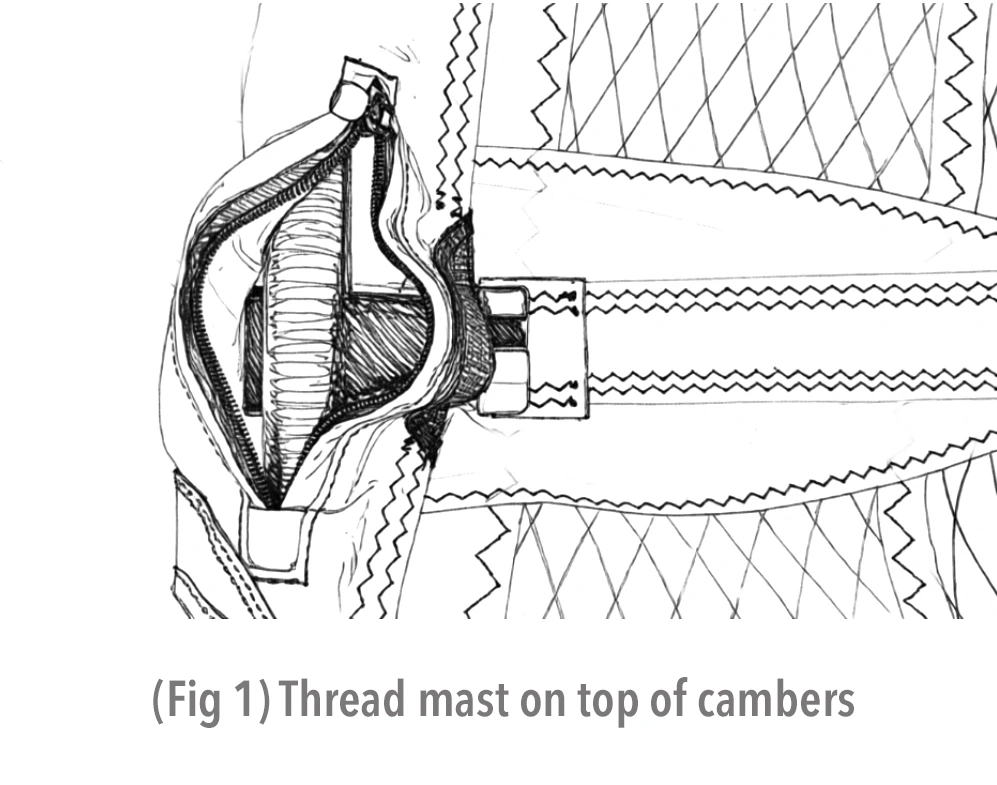
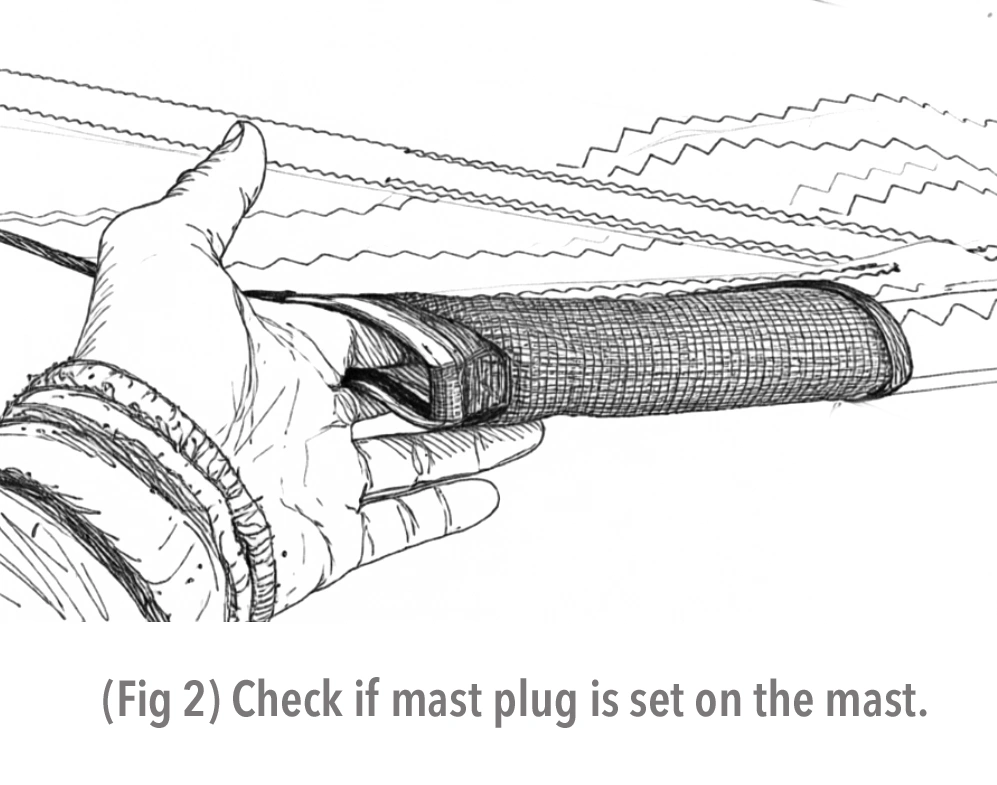
2: Insert the mast into the mast sleeve, ensuring it rests on the two ” Stubby ” cambers (Fig. 1). Verify that the male mast fitting is firmly seated at the top of the mast (Fig. 2). When first assembling the sail, ensure the fitting and the mast end are aligned and securely connected.
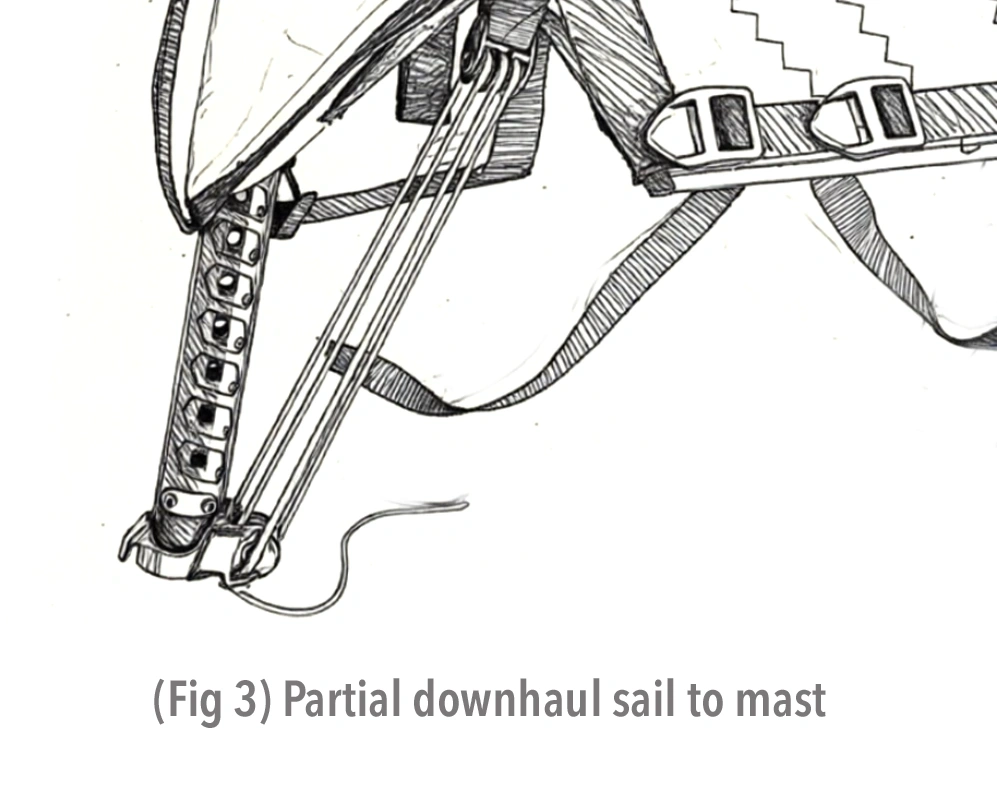
3: Attach the tack pulley to the extension base with moderate tension (Fig. 3). Apply just enough tension to the tack pulley to stretch the mast sleeve around the mast. Excessive tension at this point will make it difficult to fit the short cambers onto the mast.
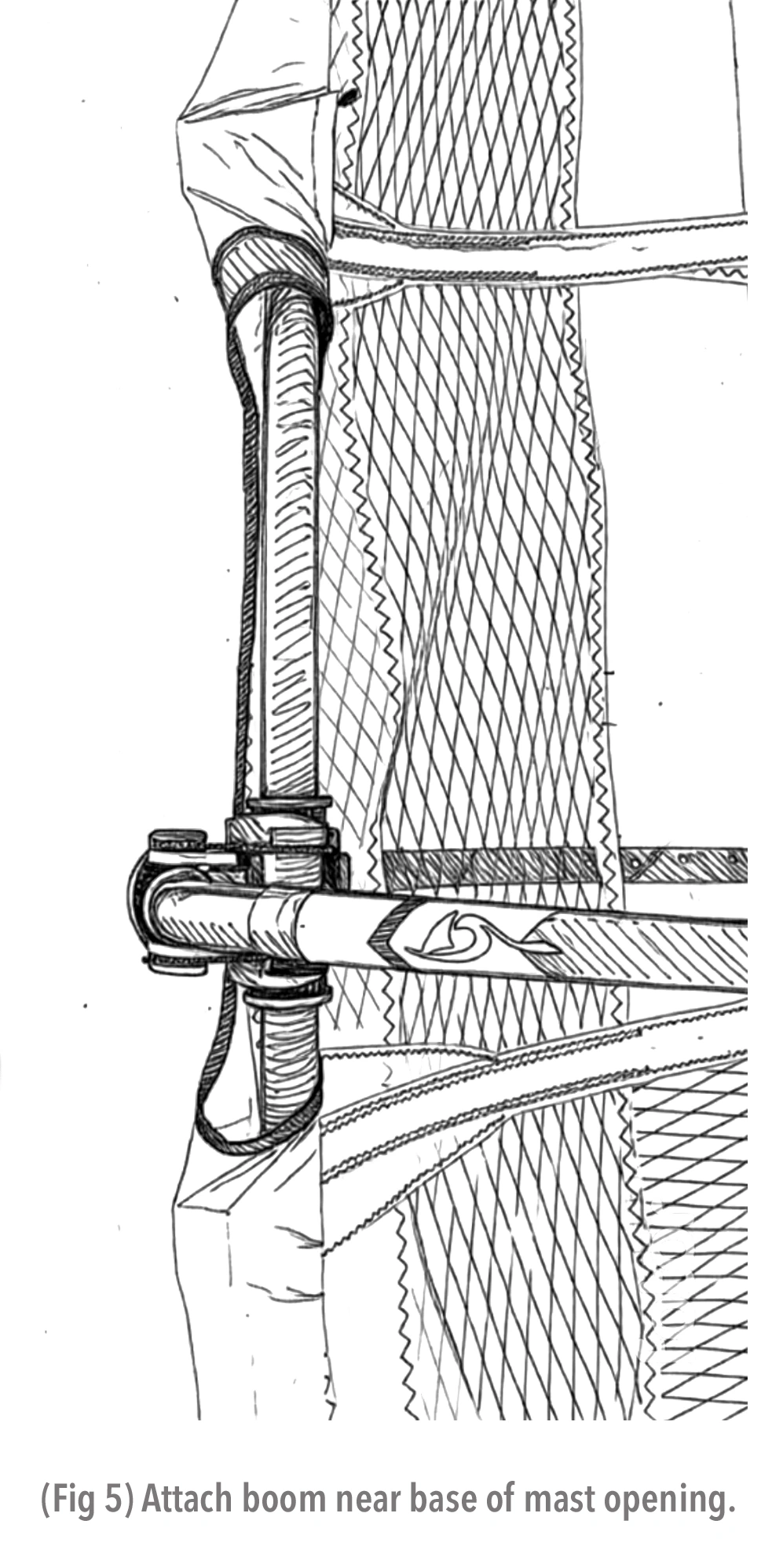
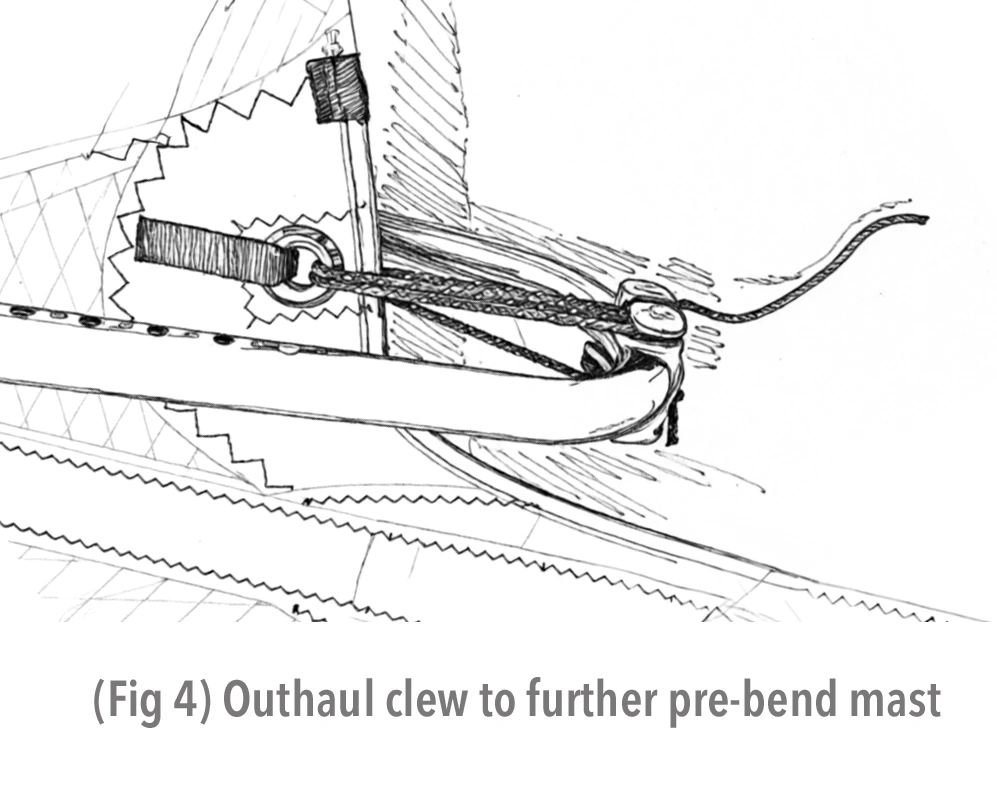
4: Secure the boom near the base of the boom opening (Fig. 5). Go to the back of the boom and pull the clew closer to the boom cleat (Fig. 4). This will flatten the sail and pre-bend the mast.
5: Go to the boom area and, with the palm of your hand, press down on the batten located behind each “Stubby” camber while pushing the piece into position with your other hand (Fig. 6). They are called “Stubbies” because they lack sides and rely on the mast cover to stay in place (Fig. 7). If the Stubbies do not stay attached to the mast, increase the downhaul tension until the mast cover is tight enough to secure them in position.
5: The more the sail is loosened, the tighter the mast cover will be around the mast, and the more difficult it will be to attach the stops. When the sail is completely loosened, it will be impossible to attach the stops. (That’s why they must be attached before the sail is completely loosened.)
7: Once the cambers are in place, it’s time to apply the full downhaul tension. The amount of tension will depend on the wind speed. The following two visual guides will help you determine the necessary tension.
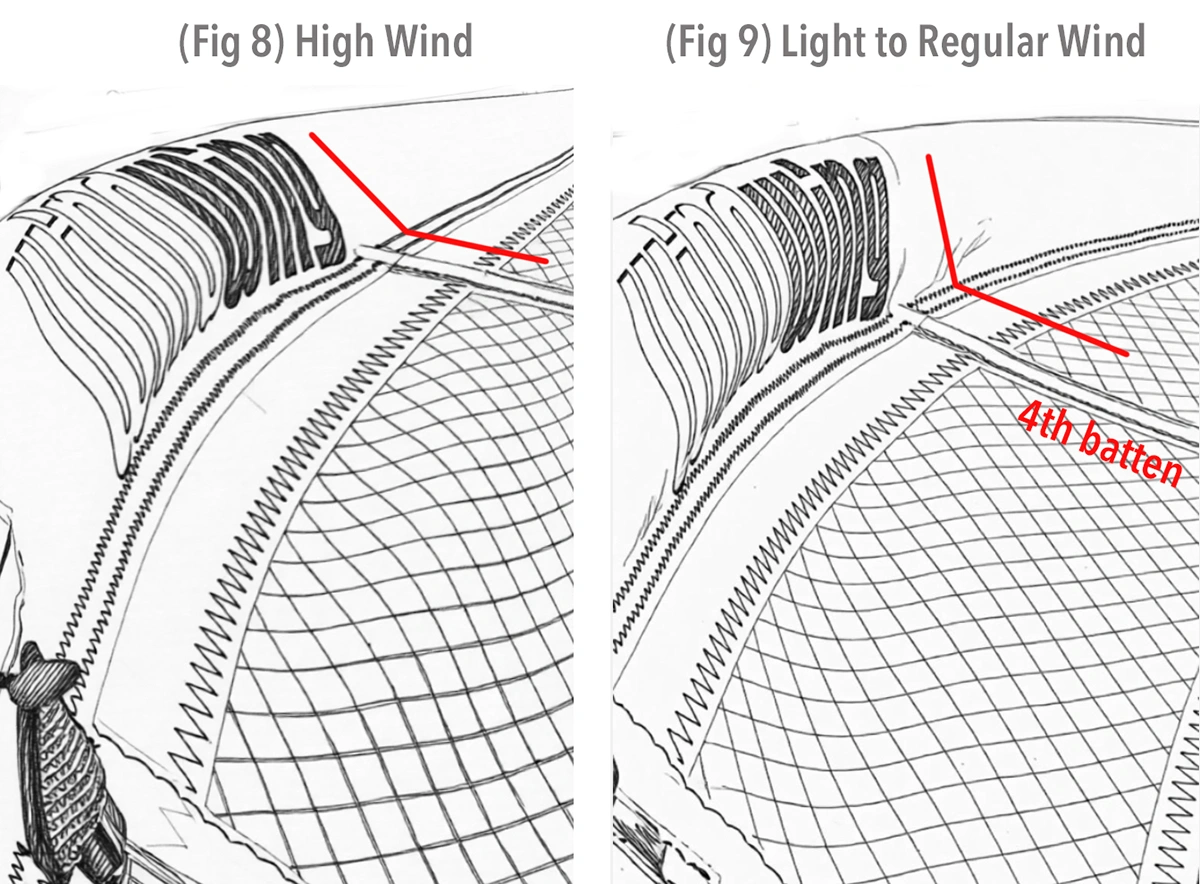
Strong wind: Constantly above 25 knots: Apply downhaul tension to the sail until the quarter batten cover is almost perpendicular to the mast (Fig. 8). If the wind does not consistently exceed 25 knots, less downhaul tension can be applied.
Light to moderate winds (8-25 knots): Apply downhaul tension until the sheath of the fourth batten forms an angle greater than 90 degrees with respect to the mast (Fig. 9). The end of the batten should always remain away from the mast, without touching it.
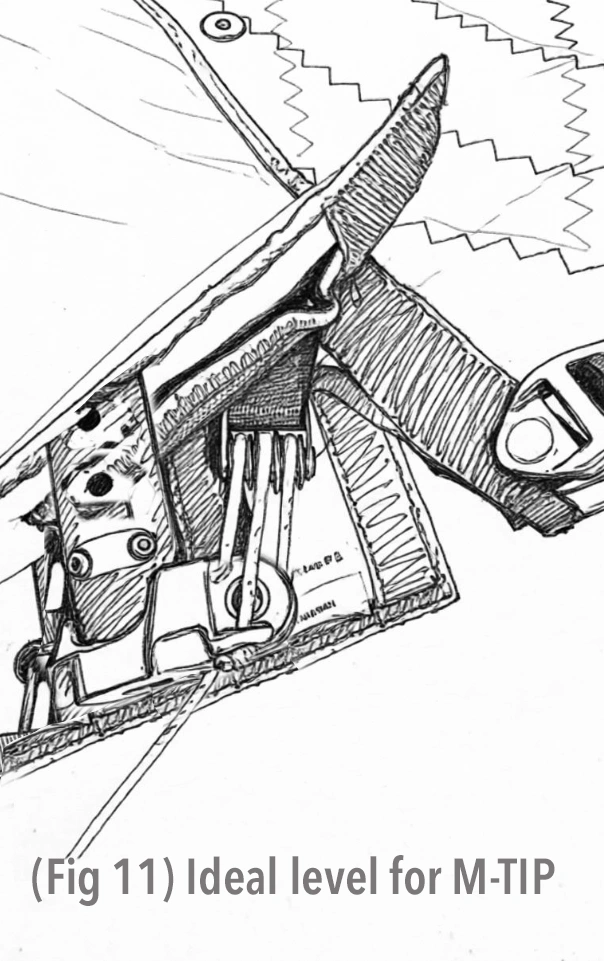
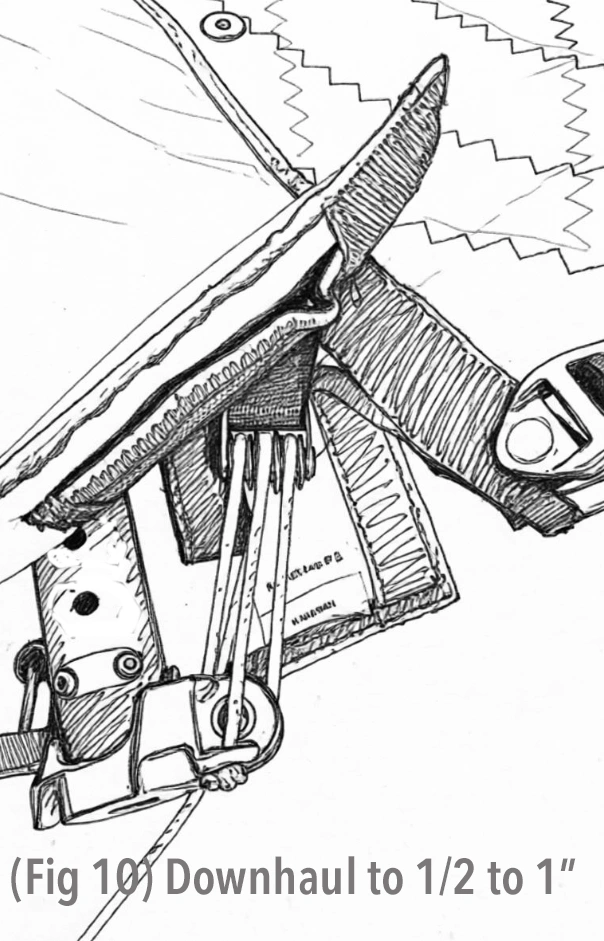 8: Thanks to the M-TIP ( Multi-Tack Inhaul Panel ), the final downhaul tension should always leave approximately one inch of pulley line visible. (Fig. 10) This is the maximum level at which the M-TIP straps canfunction effectively. This also means that, if you encounter stronger winds, you can still increase the downhaul tension and flatten the sail. A distance of between half an inch and zero from the base of the extension is the ideal level for theM-TIP(Fig. 11). In short, the M-TIP should be positioned slightly above the extension’s attachment point.
9: Once the downhaul line is adjusted, make sure the clew is free from the end of the boom and has no restrictions that prevent its retraction when the M-TIP is activated .
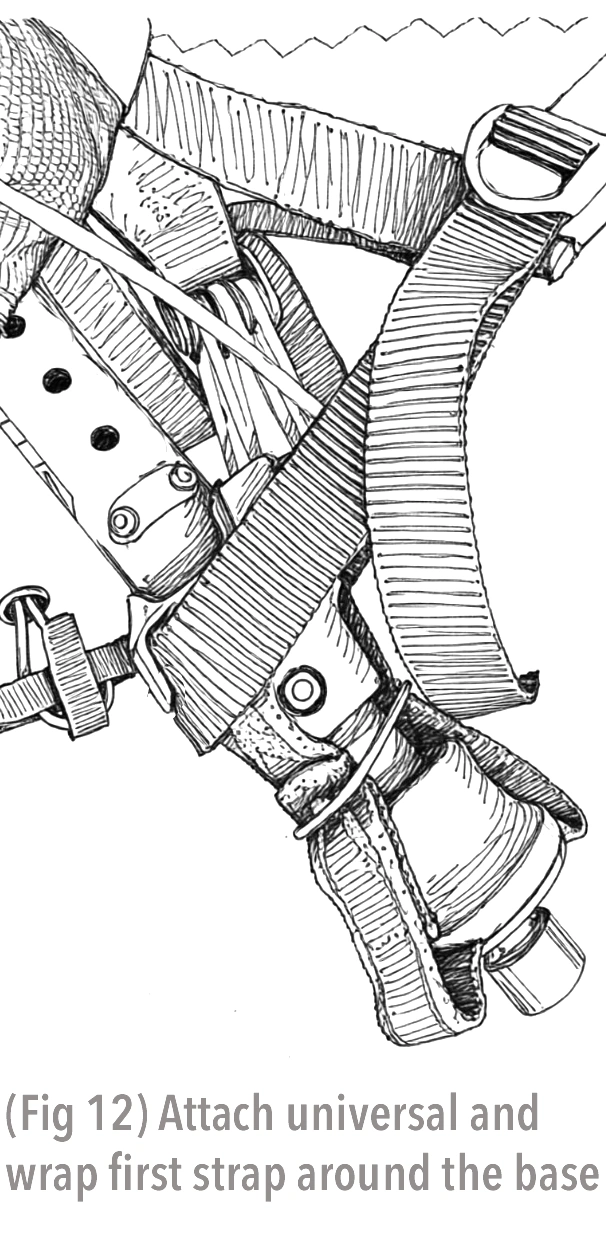
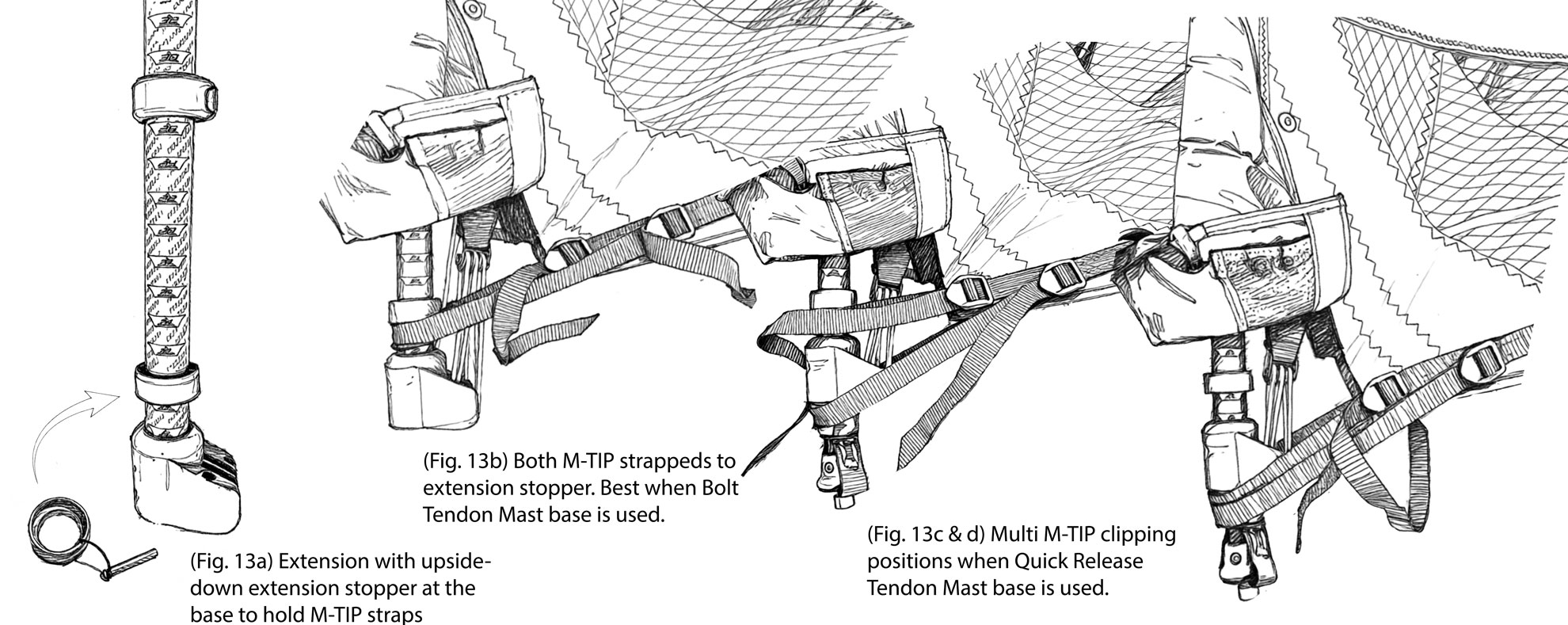
 10: Secure the tack line and connect the universal joint. Wrap the first M-TIP straps (located at the tack of the sail) around the base of the extension (Fig. 12). With RigONE or Chinook extensions, you’ll find an additional stop (Fig. 13a) that must be inserted upside down into the bottom of the extension. This will anchor the M-TIP straps and prevent them from sliding upwards. When using an extension without this stop, ensure the straps secure the edge of the extension and the universal joint (Fig. 13d). For those using conventional extensions, a quick-release tendon base is ideal, as it keeps the M-TIP in place when changing boards (Fig. 13c and d). Otherwise, the best solution is to purchase a stop ring to secure the M-TIP anchor (Fig. 13a). These solutions make changing tables quick and easy.
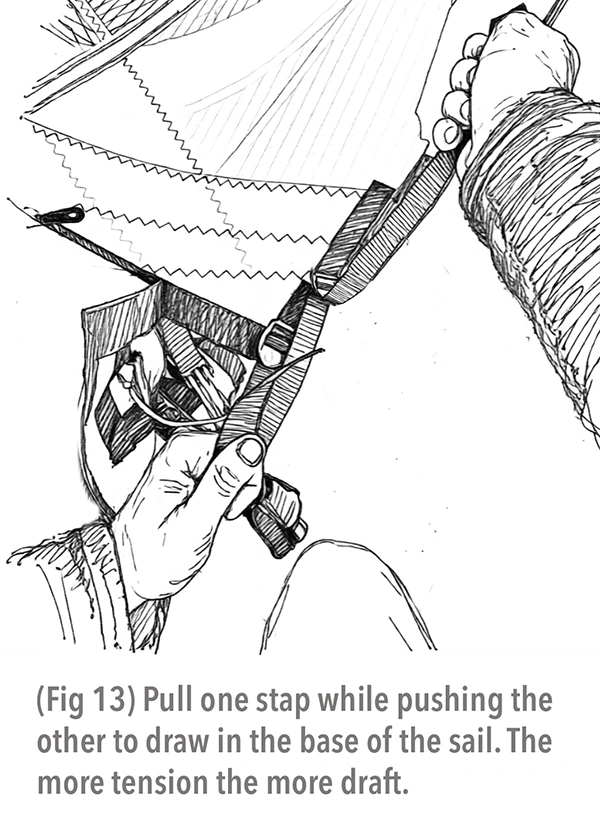
11: Wrap the second strap around the first and begin tensioning the M-TIP by pulling one strap while pushing the other in opposite directions. That is, pull the strap located at one of the stop buckles while pushing the other forward to generate the necessary tension to secure the buckle being pulled. Then, reverse the process (Fig. 12) using a crank-like motion. The tension will depend on the required curvature (bag) of the sail (Fig. 13).
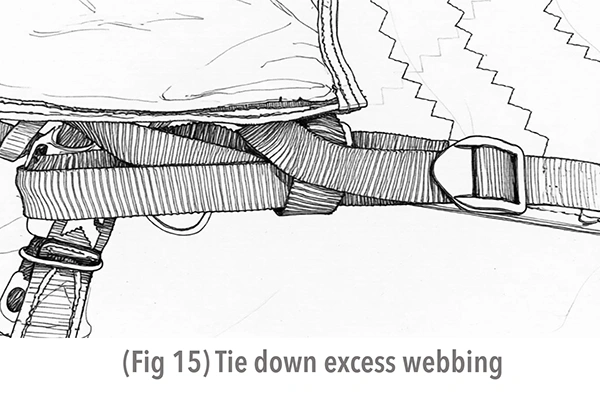
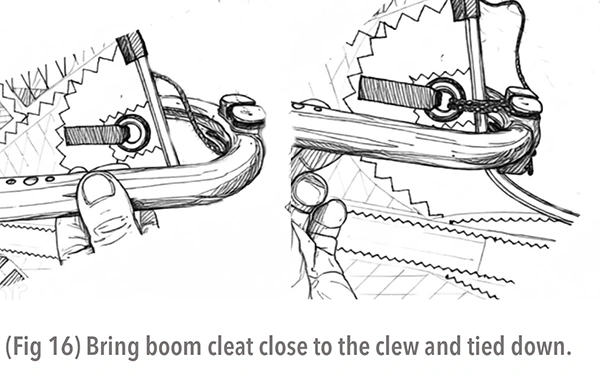
12: Secure the excess ends of the straps to the pad at the base of the mast or tie them so they are out of the way (Fig. 15). Go to the clew and attach the boom to it by applying slight tension (Fig. 16). This action secures the boom to the sail, rather than tightening the clew against the boom.
13: Go to the front of the boom and adjust the height of its leading edge. Note that the working position of the boom with RigONE gliders can be lower than with other gliders. This is because the M-TIP design generates power below the boom and minimizes aerodynamic drag above it; therefore, it is not necessary to position the boom high to leverage against the glider.
14: Once you sail the RigONE , you’ll feel the comfort and relaxation it offers. It’s fast and efficient without requiring strenuous effort. In fact, the more relaxed and upright the sailor’s posture, the faster the sail will move. Furthermore, with its lower boom, the sailor can attach to the harness lines more quickly and easily, without needing longer lines.
TROUBLESHOOTING
The sail feels heavy: Lack of downhaul tension.
The sail feels underpowered: Too much downhaul tension and lack of M-TIP tension .
The camber is not staying on the mast: When a camber (usually the lower one) slips to one side and gets caught between the mast and the sheath, performance is significantly affected. You should always correct this before resuming sailing.
Quick fix: Increase tack tension. On large sails rigged for maximum draft, the camber can shift outwards if the tack tension is insufficient. Increasing this tension will keep the camber in place.
Long-term solutions: Remove the “Stubby” camber from the batten, place the camber spacer on the batten, and reinsert the camber. Replacement camber spacers are included in the sail bag along with a batten tensioning tool.
YOU!
The madman, the misfit,
the troublemaker,
the round piece in a square world,
the windsurfer they can’t ignore because your sail… changed things.
Early production availability, exclusive pricing, insider updates.Secure Your Spot
Limited sails available