
—
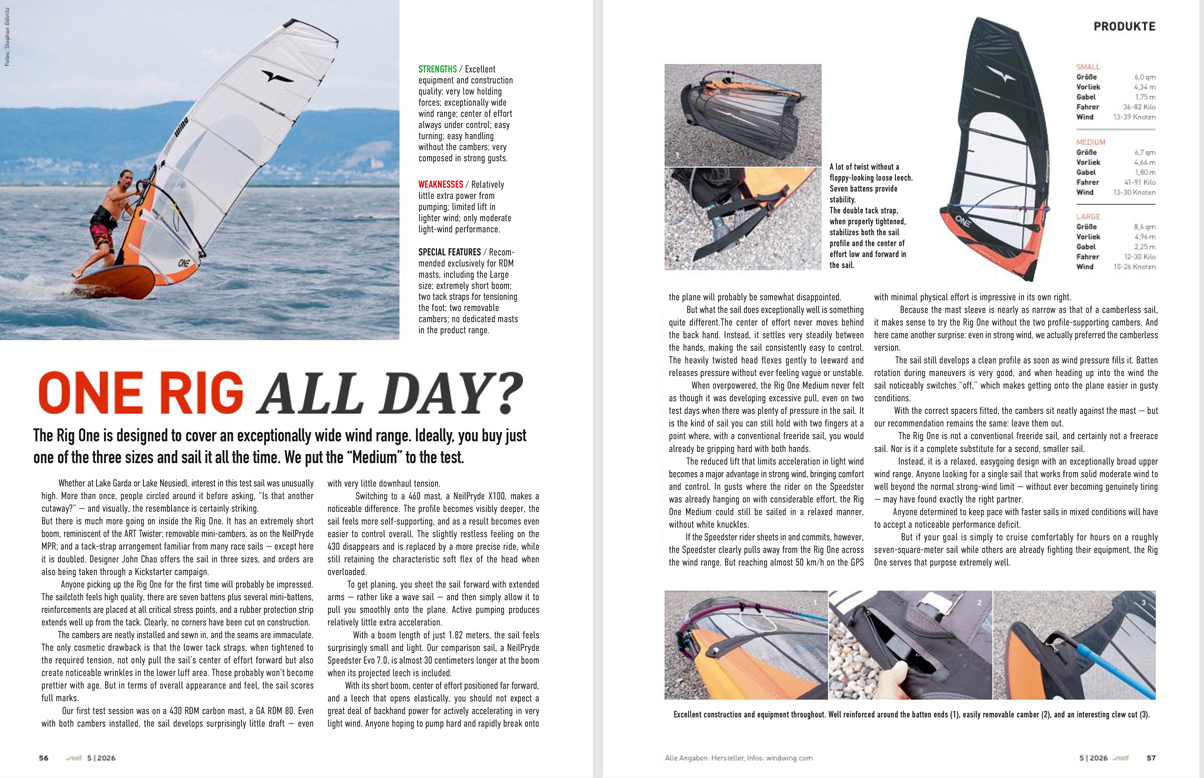
“It is the kind of sail you can still hold with two fingers at a point where, with a conventional freeride sail, you would already be gripping hard with both hands.” German SURF Magazine Test Review
—
We greatly appreciate SURF Magazine’s thorough testing of the RigONE. Their observations also highlight how differently the RigONE behaves from a conventional windsurfing sail.
—
There are three points we would like to clarify, along with two unique characteristics of the RigONE design.
—
-
Mast Compatibility — Constant Curve Is Important.
The RigONE performs best on constant-curve RDM masts. A flextop mast can slightly reduce the draft, which appears consistent with what the SURF testers experienced.
With a constant-curve mast, the M-TIP can function as designed, allowing greater draft to develop while creating controlled compression at the base of the sail — visible as the intentional wrinkle produced by the accordion effect. At the same time, the upper sail retains the tension needed to respond more effectively to changes in wind pressure and sailor input.
_
-
RigONE Uses “Fanning” Rather Than Conventional Pumping
The combination of the M-TIP, STEP-LEECH and DRAFT EXTENDERS creates a different technique for accelerating onto a plane.
Rather than using a traditional full-body pumping motion, the RigONE responds extremely well to what we call fanning — pulling and pushing the back hand in and out.
Because the sail’s primary tension line is positioned inboard and the DRAFT EXTENDERS project beyond that line, the extended sections of the leech are able to fan and snap like a whip as the sail is moved back and forth.
This produces rapid acceleration with considerably less physical effort and is an easy and effective way to bring the board onto a plane.
_
-
Lower Boom, Upright Sail and Seat Harness
The RigONE does not require the same high-boom leverage normally used to control a conventional sail. The boom can therefore be positioned considerably lower.
For this reason, we recommend experimenting with a seat harness and a more upright sail position, rather than the traditional heavily raked-back stance.
The RigONE’s ability to capture the wind while reducing drag allows the sail to be sailed more upright — maximizing its exposure to usable wind.
Or, put more simply:
Capture more wind. Create less drag. Sail more upright.At the same time, the greater downward loading created by the seat harness helps develop a deeper draft near the foot, while the tighter inboard leech line allows the upper portion of the sail to flatten and reduce drag. Simply sit on the harness rather than leaning back and out; the result is: More power where it is useful. Less drag where it is not. This combination is key to extracting RigONE’s higher-speed performance.
–
The SURF test was an excellent evaluation of the RigONE, and we greatly value the testers’ observations. Because the RigONE introduces several concepts that differ from conventional sail design, some aspects of rigging and sailing technique also require a slightly different approach.
Understanding those differences allows the RigONE’s unique characteristics — the M-TIP, STEP-LEECH, DRAFT EXTENDERS and inboard tension line — to work together as intended.