 https://www.kickstarter.com/projects/1719204830/windwing-rigone-the-one-sail-quiver
Special launch pricing • Limited early-backer offers

https://www.kickstarter.com/projects/1719204830/windwing-rigone-the-one-sail-quiver
Special launch pricing • Limited early-backer offers
—
—
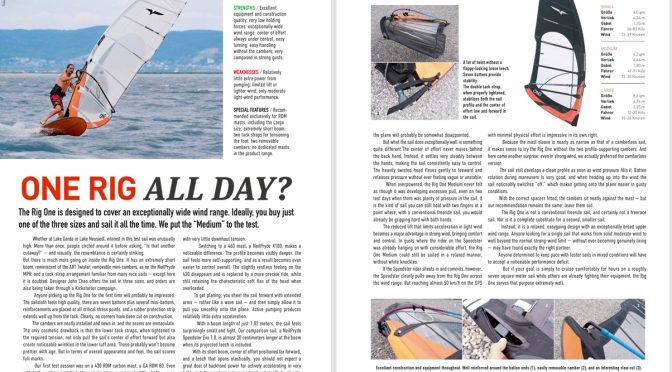
We greatly appreciate SURF Magazine’s thorough testing of the RigONE. Their observations also highlight how differently the RigONE behaves from a conventional windsurfing sail.
—
There are three points we would like to clarify, along with two unique characteristics of the RigONE design.
—
The RigONE performs best on constant-curve RDM masts. A flextop mast can slightly reduce the draft, which appears consistent with what the SURF testers experienced.
With a constant-curve mast, the M-TIP can function as designed, allowing greater draft to develop while creating controlled compression at the base of the sail — visible as the intentional wrinkle produced by the accordion effect. At the same time, the upper sail retains the tension needed to respond more effectively to changes in wind pressure and sailor input.
_
The combination of the M-TIP, STEP-LEECH and DRAFT EXTENDERS creates a different technique for accelerating onto a plane.
Rather than using a traditional full-body pumping motion, the RigONE responds extremely well to what we call fanning — pulling and pushing the back hand in and out.
Because the sail’s primary tension line is positioned inboard and the DRAFT EXTENDERS project beyond that line, the extended sections of the leech are able to fan and snap like a whip as the sail is moved back and forth.
This produces rapid acceleration with considerably less physical effort and is an easy and effective way to bring the board onto a plane.
_
The RigONE does not require the same high-boom leverage normally used to control a conventional sail. The boom can therefore be positioned considerably lower.
For this reason, we recommend experimenting with a seat harness and a more upright sail position, rather than the traditional heavily raked-back stance.
The RigONE’s ability to capture the wind while reducing drag allows the sail to be sailed more upright — maximizing its exposure to usable wind.
Or, put more simply:
Capture more wind. Create less drag. Sail more upright.
At the same time, the greater downward loading created by the seat harness helps develop a deeper draft near the foot, while the tighter inboard leech line allows the upper portion of the sail to flatten and reduce drag. Simply sit on the harness rather than leaning back and out; the result is: More power where it is useful. Less drag where it is not. This combination is key to extracting RigONE’s higher-speed performance.
–
The SURF test was an excellent evaluation of the RigONE, and we greatly value the testers’ observations. Because the RigONE introduces several concepts that differ from conventional sail design, some aspects of rigging and sailing technique also require a slightly different approach.
Understanding those differences allows the RigONE’s unique characteristics — the M-TIP, STEP-LEECH, DRAFT EXTENDERS and inboard tension line — to work together as intended.
A sail for almost all conditions, without having to re-rig: The “RigOne” stands out visually with its cut-out leech and is designed to make life easier for amateur windsurfers. The man behind the concept is John Chao, a photographer and long-standing editor of the magazine “American Windsurfer” and a veteran of the US scene. We asked him a few questions about this unusual concept.
In 2004, I lost interest in the windsurfing and kite business because I saw no future in publishing “American Windsurfer”, selling more and more expensive products and not making a difference. So I stopped publishing and put the many brands I owned, including Windwing, on hold. After a few months, I designed a sail for myself so that I would only need one sail and no more.
Obviously I’m lazy to change sails. In fact, I hate it. So my focus was on developing a sail that automatically adapts to the wind and is never overpowered. It worked so well that it kept me windsurfing for the next 22 years. I sail at the Columbia River Gorge at a spot called the “event site”. The water is fairly flat but the winds are gusty. When the wind shifts and everyone else is on the shore re-rigging, I’m almost always alone on the water. I would get a smile on my face but never thought that they could benefit from it.
The first sail I built was about 7.0 m2. That was the sail I used for 20 years, every day when the wind was blowing between 15 and 40 knots. Two years ago, I decided to build two larger and two smaller sails. One I call XL, which was a 9.0, and one in the Large size with 8.0 m2, as well as a Small version with 6.0 m2 and an XS with 5.0 m2. You can see that at this point I was fed up with waiting for the industry to catch up and started toying with the idea of bringing this to market. After a year of testing, I ended up with the 9 as a large, the 7 as a medium and the 6 as a small.

Monty Spindler has been a good friend of mine for over 30 years and I think he is the most talented sail designer in the history of windsurfing. I think he was on the right track, but the RigONE is more the opposite of the “cutaway”. There are three provisional patents, and they all work together. What looks like the cutaway is what we call the step leech. At its base is the clew. Above and below it are the so-called draft extenders. So instead of thinking of it as a cutaway, these are actually extensions that protrude from the leech and fulfil a very important function. This function enables the sail to adapt itself to the wind and minimise drag. This is why the sail has such a wide range of use. At the Defi 2026, Daniele Minoni took part in all five races at around 20 to 40 knots with a single sail, the 7-m2 medium RigONE, and came 88th – and he weighs just 66 kg!
On the lower leech we use a series of tack straps that I call the Multi-Tack Inhaul Panel, abbreviated M-TIP. This is the third provisional patent that completes the overall package. The M-TIP results in two major changes: In addition to the downhaul and outhaul, there is a now third point for trim. Even when the sail is trimmed flat, the M-TIP brings the profile back to the lower edge of the sail, which tapers towards the top. More importantly, the M-TIP pretensions a load line between the foot, clew and masthead. This tension forms an inboard load line between the foot of the sail and the clew, extending over the step leech to the top of the mast. When the sail turns in the wind, the extended part of the sail presses against the internal load line, smoothing the upper profile and minimising drag. The same applies below the boom. Essentially, the sail shrinks in a gust and reshapes itself when the wind dies down.

The sail is designed for RDM masts with constant curve, so any mast will work. The sail has two cambers, which we call “stubbies” because they are not a wishbone-like camber and lock easily onto the mast. The profile is held solely by the mast sleeve. This makes rigging simple and uncomplicated.
We want this sail to be a grassroots revolution and are not really interested in convincing importers or dealers to sell it. We will offer it once a year as part of a Kickstarter project, each sail would cost less than 800 US dollars, and you can create add-ons for a Chinook mast, boom and extension at a further package discount. If we reach the target of 200 sails we will produce, otherwise we will not charge backers and wait for next year. Given the comments that have flooded our websites, I think we are already there.
More under windwing.com
A test sail from RigOne is already on its way to the surf test cellar! You’ll soon find out how the sail rides and whether the concept works here at surf-magazin.de!